
As 2025 comes to an end, one thing is abundantly clear: the concept of traditional vulnerability management has been turned on its head. Security teams have realized the inefficiencies of periodic vulnerability scans, and that spending time and resources sifting through a backlog of alerts is no longer sufficient to reduce risk. This has introduced CTEM (Continuous Threat Exposure Management) as a proactive framework; and Exposure Assessment Platforms (EAPs), have been recognized as the foundational layer to support these initiatives.
With the release of the Gartner® 2025 Magic Quadrant™ for Exposure Assessment Platforms in November, we feel this evolution of vulnerability management has become mainstream. For the first time, Gartner formally evaluated EAPs as a discrete category, defining the capabilities modern security teams should consider when evaluating vendors to support their security operations.
Let’s explore what changed in 2025, why EAPs matter now more than ever, and how they enable the shift from vulnerability management (VM) to continuous exposure management.
A Perfect Storm for Exposure Management
Continued Expansion of Attack Surfaces and Hybrid Complexity
No matter the size of the organization, its infrastructure is dynamic and includes SaaS applications, mobile devices, remote work endpoints, unmanaged assets, identity systems, shadow IT, constantly changing configurations, EOL systems, and more. Legacy VM tools, built for static network environments and periodic scanning, can’t keep up.
Overwhelming Volume — and Poor Signal to Noise Ratio
Between CVEs, configuration drift, missing compensating controls, and third-party dependencies, security teams are drowning in data. Yet the disparate data provided from siloed tools doesn’t translate to actionable data to reduce real, exploitable risk. Better data is needed to make better decisions.
Demand for Business Context to Better Determine Risk
The board and executives are increasingly demanding metrics that map directly to business risk, not just the number of CVEs that were addressed or the patches that were pushed. They want to know: Where are we truly exposed? What would it cost us — operationally and financially — if these exposures were exploited? Exposure management, with its emphasis on context and prioritization, answers these questions.
Industry Recognition — Gartner Validates EAPs
In our opinion, the publication of the 2025 Gartner® 2025 Magic Quadrant™ for Exposure Assessment Platforms defined the shift away from traditional vulnerability management to the broader and more holistic approach of CTEM. According to Gartner, “The core purpose of EAPs is to provide a better, consolidated view of high-risk exposures enabling organizations to take key proactive actions to prevent breaches.”1.
What Is an Exposure Assessment Platform (EAP)
An EAP is a solution that continuously discovers and inventories a broad range of assets (from devices and cloud workloads to identities and applications), identifies exposures (vulnerabilities, misconfigurations, missing controls, etc.), and prioritizes them in the context of real-world exploitability, business impact, and existing security controls.
Compared to traditional VM tools, EAPs deliver several critical advantages:
- Unified visibility across all asset classes — not just servers or endpoints. An EAP should be built on a foundation of comprehensive asset inventory that includes applications, devices, users, and vulnerabilities – and the complex relationships between them. This eliminates blind spots caused by siloed inventories.
- Context-driven prioritization — vulnerabilities are more than CVEs. Exposures are not simply ranked by severity scores—asset inventory, threat intelligence, and business context are unified to enable holistic prioritization—not one based on a number.
- Continuous, real-time assessment — instead of quarterly or monthly scans, EAPs support continuous monitoring and detection, ensuring full and complete visibility as the attack surface constantly evolves.
- Remediation and validation workflows — beyond detection, EAPs support or integrate with remediation workflows and validation cycles, facilitating the full CTEM lifecycle.
- Business-aligned metrics — rather than simply reporting on the “number of vulnerabilities,” security teams can report on meaningful measurements like exploitable exposure reduction, mean time to remediation (MTTR), unmet SLAs, and patch efficacy.
EAPs and the CTEM Lifecycle: From Discovery to Remediation
The shift to EAPs is aligned with the CTEM framework. Here’s how EAPs support each phase of that lifecycle:
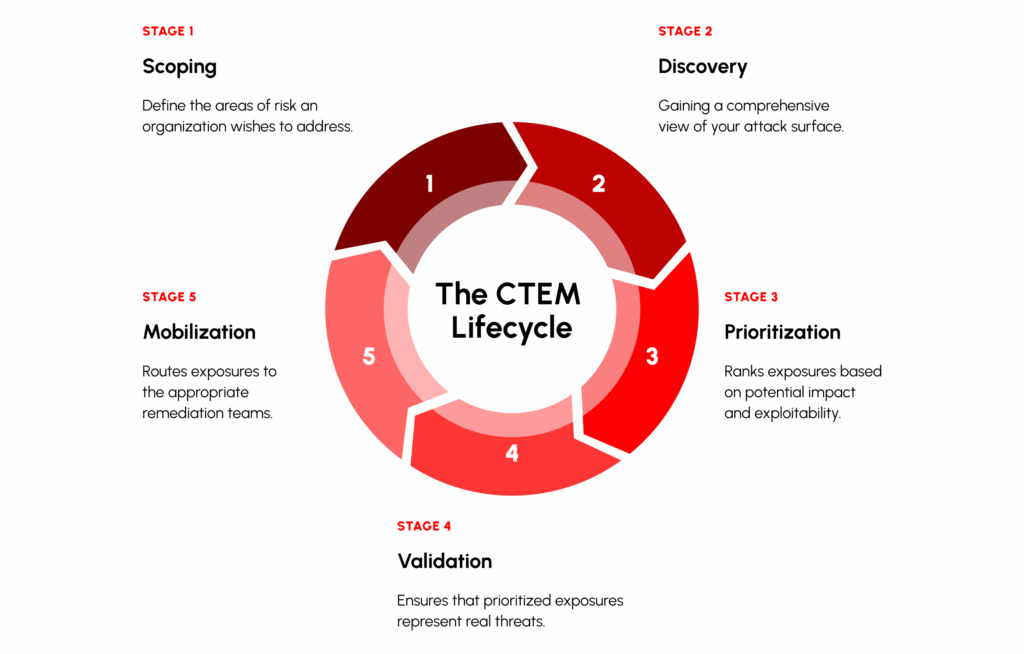
By consolidating these functions into a single platform, EAPs help break down the silos created by having multiple tools for VM, Cyber Asset Attack Surface Management (CAASM), threat intelligence, and more. For security teams, this means less manual consolidation of data from multiple tools, fewer blind spots, less alert fatigue — and more effective risk reduction.
Why 2025 Was the Year EAPs Came Into the Spotlight
Several factors converged this year:
- The continued explosion of cloud, remote work, identity sprawl, and hybrid environments – especially as more employees were called back into the office several days a week.
- The mounting volume of vulnerabilities and exposures that traditional vulnerability management tools couldn’t effectively triage.
- A growing need for business-aligned risk reporting and outcome-oriented security metrics.
- The formal acknowledgment by Gartner with the publishing of the inaugural Gartner® Magic Quadrant™ for EAPs which replaced the Market Guide for Vulnerability Assessment.
This combination of factors created the right environment for EAPs to move from being thought of as a “nice-to-have,” to being a consideration for the foundation for modern security programs.
The Sevco Perspective
Security frameworks including NIST, CIS, ISO, PCI, HIPAA, GBLA and more, have had an accurate asset inventory as control number one. Sevco’s original vision was to deliver this foundation, but we have evolved from our CAASM roots into a full-fledged Exposure Assessment Platform.
We provide the clarity, context, and continuous monitoring that modern security teams need to operationalize CTEM — not just as a concept, but as a real, measurable program.
Sevco Security is honored to have been named a Visionary in the 2025 Gartner® Magic Quadrant™ for Exposure Assessment Platforms. Access the report here: https://www.sevcosecurity.com/gartner-magic-quadrant-exposure-assessment-platforms/
2026 should be the year many organizations finally move from reactive firefighting to proactive risk reduction. If you haven’t yet evaluated what adopting an EAP like Sevco can do for your team, now is the time. Book a demo today.
Gartner does not endorse any vendor, product or service depicted in its research publications, and does not advise technology users to select only those vendors with the highest ratings or other designation. Gartner research publications consist of the opinions of Gartner research organization and should not be construed as statements of fact. Gartner disclaims all warranties, expressed or implied, with respect to this research, including any warranties of merchantability or fitness for a particular purpose.
Gartner and Magic Quadrant are trademarks of Gartner, Inc. and/or its affiliates. .
1. Source: Gartner, Magic Quadrant for Exposure Assessment Platforms, Mitchell Schneider, Dhivya Poole, Jonathan Nunez, 10 November 2025.